Skip to content
Riser & Rail

05 — Safety & Certifications

Is Polycarbonate BPA-Free? And Does It Matter at a Desk?

No polycarbonate is BPA-free — BPA is the monomer it is built from. Whether that should change what you buy depends on a route of exposure almost nobody discusses, and on what the alternative is made of.

By Stephen V.Updated How we research
#ad

We earn a commission when you buy through our Amazon links, at no extra cost to you. It never affects our rankings, and we say so when the cheaper — or the direct-only — product is the better buy. How this works.

No. Polycarbonate is not BPA-free and cannot be — bisphenol A is the monomer the polymer is built from, which the FDA states plainly when it calls BPA "a structural component in polycarbonate beverage bottles". A product sold as "BPA-free polycarbonate" is either mislabeled or is not polycarbonate. What that should change about a home office is much narrower than the phrase suggests, and this page is about the narrow part: a clear rigid sheet on your floor is a different exposure question from a hot drink in a bottle, and the honest answer to "should I avoid it" depends entirely on what you would buy instead.

Where the BPA in polycarbonate actually is

Polycarbonate is made by reacting bisphenol A with a carbonate source into long chains. Once the reaction is done, almost all of the BPA is chemically bound into the polymer backbone and is not free to go anywhere. What can migrate is the small residue that never reacted, plus whatever is released if the chains break back down — which is why every migration study you will find is about heat, hydrolysis and abrasion, and why the research literature is overwhelmingly about food and drink containers rather than about sheet goods.

That matters for the products in this category, because the conditions that drive migration in a bottle mostly do not exist under a desk:

  • No heat. A chair mat sits at room temperature. Nothing is being microwaved, dishwashed or filled with boiling water.
  • No liquid in contact with it for hours. Hydrolysis needs water and time.
  • Very little skin contact. You touch a chair mat with caster wheels, shoes, and occasionally bare feet. That is the route that matters here, and it is the one California has put a number on — below.

We have not tested a chair mat and we do not run a lab. What we will not do is assert a migration figure for a dry polycarbonate sheet at room temperature, because we looked for one and did not find one. The absence of a measurement is not a safety claim in either direction, and anyone telling you a number for this specific product is almost certainly borrowing one from a bottle study.

What the FDA says

The FDA's consumer position on BPA in food-contact uses is a single sentence: "BPA is safe at the current levels occurring in foods." That is the federal regulator's conclusion about dietary exposure, which is the dominant exposure route for most people and is not the route a chair mat represents.

There is a second piece of FDA history that gets misread constantly, so it is worth stating correctly. In July 2012 the FDA amended its regulations to stop allowing polycarbonate resins in baby bottles and sippy cups. The amendment was made on the grounds that the industry had abandoned that use — not on the grounds that the agency had found it unsafe. If you have read that "the FDA banned BPA in baby bottles", this is the thing that happened, and the distinction between abandonment and a safety finding is the entire point.

What California says, and the one number worth knowing

California reached a different place, through a different process. Bisphenol A was listed under Proposition 65 as causing female reproductive toxicity on May 11 2015, after the state's expert committee determined it had been clearly shown through scientifically valid testing to cause reproductive toxicity on the female endpoint. A separate developmental toxicity endpoint was reinstated on December 18 2020. This is why you can find a retail listing for a polycarbonate chair mat carrying a Prop 65 BPA warning — a fact we recorded when we built the chair mats roundup, and the reason this page exists.

The genuinely useful number is the safe-harbor level, because Prop 65 is a warning law rather than a ban and its thresholds tell you what the state thinks an exposure of concern looks like. For BPA, OEHHA set a Maximum Allowable Dose Level of 3 micrograms per day for dermal exposure from solid materials, and defined solid materials as materials in solid form including paper and plastics. Below that level, a business is not required to warn.

Read what that regulation is for. The state wrote a dedicated safe-harbor level for touching solid BPA-containing plastic — exactly the category a chair mat, a monitor riser or a clear desk shield falls into. It is a small number, three millionths of a gram a day, and the relevant question for a mat is not whether the material contains BPA (it does) but whether skin contact with it is anywhere near that. For a sheet you roll a chair over in shoes, that is a much easier case than for a bottle you drink from. Our Prop 65 explainer sets out how to read these warnings generally: a warning is a disclosure that an exposure may occur, not a measurement of your exposure.

Where polycarbonate shows up in a home office

You will meet it more often than you would guess, because it is the clear, rigid, impact-tough plastic:

  • Chair mats. The main one. Rigid polycarbonate is the premium chair-mat material and the reason is good: it needs no plasticizer, so the migration question that follows flexible vinyl does not arise. See chair mats, ranked by material.
  • Monitor risers, desk shields and drawer fronts. Clear rigid panels are commonly polycarbonate or acrylic, and listings rarely say which.
  • Reusable water bottles of a certain age. The hard, clear, slightly amber ones. These are the actual high-temperature, high-contact use, and they are the reason the phrase "BPA-free" exists at all.
  • Equipment housings and lenses. Laptop parts, light diffusers, safety glasses. No meaningful skin-contact or ingestion route.

One labeling note that will save you time: acrylic is not polycarbonate. They look identical in a photograph and are built from entirely different monomers, so a clear rigid panel being "BPA-free" is plausible if it is acrylic or a PET-based sheet, and is not plausible if the listing also calls it polycarbonate. If a listing claims both, write to the seller or buy something else.

The trade you are actually making

Here is the part most "BPA-free" shopping gets wrong: avoiding polycarbonate in this category usually means buying flexible PVC instead, and that swaps one material question for a bigger one.

A flexible vinyl mat is soft because it contains plasticizer, typically a phthalate, which is not bound into the polymer the way BPA is bound into polycarbonate. It is a free additive that can migrate out over time — the mechanism behind the staining and softening you see when a vinyl mat sits on a vinyl floor, which we work through in phthalates in office furniture. So the ranking is not "polycarbonate bad, vinyl good". It is:

  1. A material with nothing to migrate — bamboo, tempered glass. No monomer question, no plasticizer question.
  2. A bound monomer — rigid polycarbonate. BPA is in the backbone; the residual is what is at issue, and the state's own dermal threshold is the yardstick.
  3. A free additive — flexible PVC with plasticizer, unless the maker specifically publishes a phthalate-free formulation.

That ordering is why our chair-mat roundup ranks the rigid polycarbonate first for hard floors and still says, in the same breath, that you are trading the plasticizer question for the BPA question rather than escaping both. If the BPA question is the one that bothers you, the answer is not a different plastic. It is a different material class.

What "BPA-free" is worth on a desk product

Three honest limits on the label:

  • It is a claim, not a certification. There is no registry to check a "BPA-free" badge against, unlike GREENGUARD for emissions or OEKO-TEX for textiles. If a certification is what you want, those are the ones that exist for furniture.
  • It tells you what is absent, not what replaced it. A BPA-free rigid sheet is some other polymer, and the listing usually will not say which. "Not polycarbonate" is not the same as "inert".
  • On a chair mat, it is often technically true and practically irrelevant — a vinyl mat is genuinely BPA-free, and its material question is the plasticizer, which the badge does not mention.

So what should you buy?

If you have read this far because you want the BPA question gone rather than managed, there are exactly three ways to do it in this category, and all three are below. They are deliberately not the top pick on our chair-mat roundup, which stays the rigid polycarbonate for most hard floors on migration grounds. These are the mats for the reader whose filter is "no BPA-based polymer in the room":

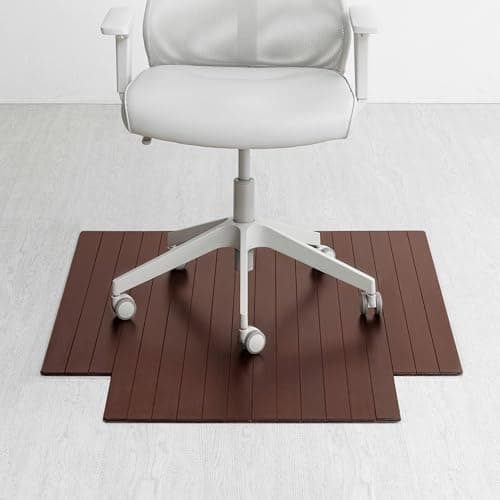
  • Bamboo is the practical answer for most rooms: a hard natural surface with no monomer and no plasticizer, and it works on both hard floor and low pile.
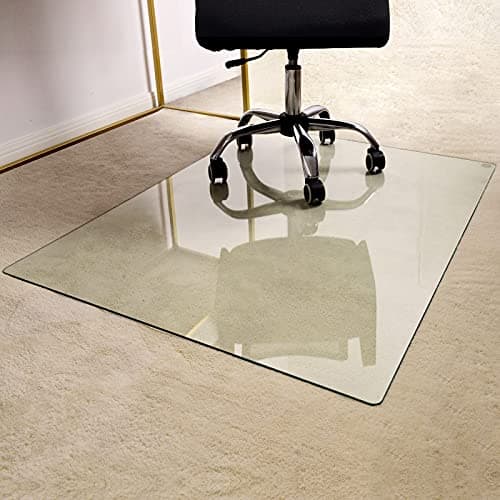
  • Tempered glass is the absolute answer — no polymer at all, nothing to migrate, nothing to off-gas, and it will outlast the desk. It is heavy, it is cold underfoot and it costs the most.
  • A published phthalate-free vinyl is the compromise if you need a flexible, light, cheap mat: you keep the plasticizer class but the maker has published that the phthalate is not in it, which is more than most vinyl mats offer.

And whichever you buy, the thing that does most for the air in a small office is not a material choice at all. It is ventilation during the first week of anything new, which the EPA's own indoor-air guidance puts ahead of almost everything else — the protocol is in the first 72 hours.
The short answer

Quick picks

#ProductBest forScorePrice
01
Anji Mountain Anji Mountain Bamboo Office Chair Mat (48 x 36 in, 5 mm)
Anji Mountain Bamboo Office Chair Mat (48 x 36 in, 5 mm)

The one mat here that is not a sheet of polymer — bamboo slats on felt, answering the materials question by construction instead of by claim.

A buyer whose filter is what the thing is made of rather than whether it is clear
7.6
$103.83Amazon
02
GLSLAND GLSLAND Tempered Glass Office Chair Mat (36 x 46 in)
GLSLAND Tempered Glass Office Chair Mat (36 x 46 in)

Glass: no polymer, no plasticizer, no BPA, nothing to off-gas — and a sheet of glass you have to be willing to live with.

Thick carpet, and anyone who wants the materials question closed rather than argued
8.2
$60.99Amazon
03
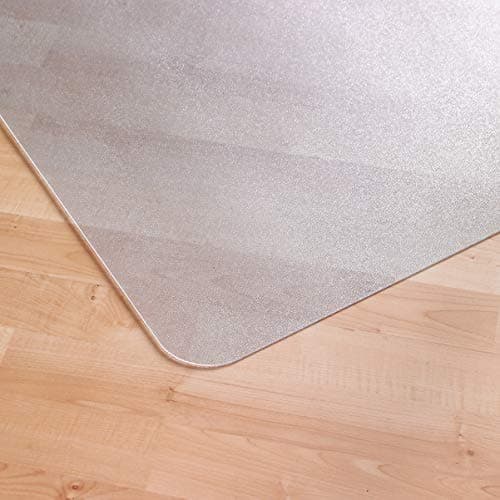
Floortex Floortex Cleartex Advantagemat Phthalate-Free PVC Chair Mat for Hard Floors (60 x 48 in)
Floortex Cleartex Advantagemat Phthalate-Free PVC Chair Mat for Hard Floors (60 x 48 in)

A vinyl mat that answers the phthalate question by substitution — and the one pick where phthalate-free versus plasticizer-free actually changes the advice.

Someone who wants a flexible vinyl mat without the phthalates that usually come with one
6.8
$76.25Amazon

#ad · Live prices from the Amazon Product API, as of November 23, 2026. Where we have no verified live price, we show none — we would rather leave a gap than print a number that has rotted.

In detail

The picks, in full

01
Anji Mountain Anji Mountain Bamboo Office Chair Mat (48 x 36 in, 5 mm)

A buyer whose filter is what the thing is made of rather than whether it is clear

Anji Mountain Bamboo Office Chair Mat (48 x 36 in, 5 mm)

48 x 36 in5 mm Moso bamboo slatsFelt backing, gripper dotsCarpet or hard floor

Certification & materials

Retail listings describe this mat as 100% Moso bamboo in roughly 2-inch slats over a felt backing with non-slip gripper dots, finished with a UV-cured coating, and state that it meets the European E1 formaldehyde emissions class. Read that carefully, because it is exactly the kind of claim this site exists to unpack: E1 is an emissions CLASS for wood-based panels, not a third-party certificate with a number you can look up, and the claim sits on reseller listings rather than on a certificate we could retrieve. It is still a real and relevant class statement — and structurally, a slatted natural material on a felt backing has no plasticizer in it to migrate into your floor, which is the most common way a chair mat damages the thing it is protecting. Anji Mountain publishes no GREENGUARD or comparable indoor-air certificate for it that we could verify.

7.6/10

The one mat here that is not a sheet of polymer — bamboo slats on felt, answering the materials question by construction instead of by claim.

Floor protection
8
Materials & certs
8
Roll quality
7
Durability
8
Value
7

Pros

  • No plasticizer anywhere in it, so the migration-staining risk that applies to any vinyl mat is simply not present
  • Looks like furniture rather than a sheet of plastic, which is why it survives in a room people live in
  • Rated for both low pile and hard floors, so it moves with you

Cons

  • Slats on felt are a jointed surface — casters make more noise on it than on a continuous sheet
  • The E1 statement is a class claim on a listing, not a certificate number you can verify in a registry
  • Heavier and more expensive than vinyl, and it will not lie flat over deep pile

Don't buy this if…

…you want silence. A bamboo slat mat is quieter than it looks but noisier than glass or polycarbonate under hard casters.

$103.83View on Amazon

Price as of November 23, 2026. Prices change — Amazon's is the one that counts.

#ad · we may earn a commission from this link to Anji Mountain Bamboo Office Chair Mat (48 x 36 in, 5 mm)

02
GLSLAND GLSLAND Tempered Glass Office Chair Mat (36 x 46 in)

Thick carpet, and anyone who wants the materials question closed rather than argued

GLSLAND Tempered Glass Office Chair Mat (36 x 46 in)

36 x 46 inTempered glass1/6 in thick (listing)4 anti-slip pads

Certification & materials

Tempered glass is the one material in this category with nothing to disclose: it is inorganic, it has no plasticizer, no BPA and no VOC story, and it cannot migrate anything into the floor under it. That is a materials fact rather than a certificate, and it is the strongest materials position on this page. The listing describes it as tempered, "shatterproof", 1/6 in thick, with four anti-slip pads, and we are reporting those as the listing's figures. Treat "shatterproof" with the care any glass claim deserves — tempered glass is far stronger than annealed glass and breaks into blunt granules rather than shards, but no glass is unbreakable, and a dropped monitor arm is a different event from a rolling chair.

8.2/10

Glass: no polymer, no plasticizer, no BPA, nothing to off-gas — and a sheet of glass you have to be willing to live with.

Floor protection
9
Materials & certs
9
Roll quality
9
Durability
8
Value
6

Pros

  • Nothing in it to off-gas, migrate or plasticize — the materials question is answered by the material
  • Glides better than any polymer mat; on thick carpet it is the only surface that feels like a hard floor
  • Does not dish, curl, cloud or crack along the caster tracks

Cons

  • Heavy and rigid, which makes it a two-person placement and a poor fit for a room you rearrange
  • Hard, cold and loud underfoot, and it shows every speck of dust
  • It is glass. "Shatterproof" is the listing's word rather than a guarantee, and the edge is a trip point if it sits proud of thick pile

Don't buy this if…

…there are small children or a dog at speed in the room, or you move the desk often. The materials answer is excellent and the object is unforgiving.

$60.99View on Amazon

Price as of November 23, 2026. Prices change — Amazon's is the one that counts.

#ad · we may earn a commission from this link to GLSLAND Tempered Glass Office Chair Mat (36 x 46 in)

03
Floortex Floortex Cleartex Advantagemat Phthalate-Free PVC Chair Mat for Hard Floors (60 x 48 in)

Someone who wants a flexible vinyl mat without the phthalates that usually come with one

Floortex Cleartex Advantagemat Phthalate-Free PVC Chair Mat for Hard Floors (60 x 48 in)

60 x 48 inPhthalate-free PVCHard floorsFlexible sheet

Certification & materials

The listing title itself states "Phthalate Free PVC", which is an unusually specific claim for this category and a genuine point in its favor: the eight phthalates the US CPSC restricts are restricted in children's toys and child care articles, not in office furniture, so in a chair mat a phthalate-free formulation is a voluntary choice rather than a compliance one. Here is the part the claim does not cover, and we would rather say it than sell past it. Phthalate-free is not plasticizer-free. Flexible PVC is flexible because something plasticizes it, and Shaw's own technical bulletin on plasticizers states that plasticizers "are not chemically bound to the polymer so they are able to move freely through a product to the surface", that there is "no known way to stop this phenomenon", and that a rubber mat left on vinyl flooring can stain it. If your floor is LVP or sheet vinyl, that mechanism is the reason to choose a rigid mat over any flexible one, phthalate-free or not.

6.8/10

A vinyl mat that answers the phthalate question by substitution — and the one pick where phthalate-free versus plasticizer-free actually changes the advice.

Floor protection
7
Materials & certs
7
Roll quality
7
Durability
6
Value
7

Pros

  • A specific, checkable material claim in a category where almost nobody makes one
  • Flexible vinyl is cheaper, lighter and easier to position than polycarbonate or glass
  • 60 x 48 in is genuinely large — most chairs stay on it without anyone thinking about where the chair is

Cons

  • Phthalate-free is not plasticizer-free, and plasticizer migration is the mechanism behind vinyl marking a vinyl floor
  • Flexible mats dish under casters and curl at the corners over years in a way rigid mats do not
  • No third-party emissions certificate published for it that we could verify

Don't buy this if…

…the floor underneath is LVP, sheet vinyl or anything plasticized. Vinyl against vinyl is the one combination with a documented staining mechanism — buy the polycarbonate or the bamboo instead.

$76.25View on Amazon

Price as of November 23, 2026. Prices change — Amazon's is the one that counts.

#ad · we may earn a commission from this link to Floortex Cleartex Advantagemat Phthalate-Free PVC Chair Mat for Hard Floors (60 x 48 in)

A five-minute decision procedure

  1. Decide whether skin contact is real for you. If you work in shoes and the mat only meets casters, the dermal route the state regulates is close to absent and polycarbonate is a reasonable buy. If you work barefoot on the mat for hours a day, you have a genuine reason to pick a non-polymer surface.
  2. Identify the material, not the marketing. Find the words "polycarbonate", "PVC", "vinyl", "PET", "acrylic" or "bamboo" in the listing. If none of them appear, the seller is not telling you what you are buying, which is itself the answer.
  3. If you are avoiding BPA, do not land on flexible vinyl by accident. It is BPA-free and it is the one material class in this category with a documented migration mechanism of its own. Either buy a published phthalate-free formulation or step out of plastics entirely.
  4. Treat a Prop 65 warning as information. It means an exposure may occur above a safe-harbor level, and for BPA that level is 3 micrograms a day by skin contact with a solid. It is not a product recall and it is not a measurement of your own exposure. See how to read a Prop 65 warning.
  5. Ventilate whatever arrives. Every new polymer product in a small room benefits from a week of air more than it benefits from any badge on the box.
  6. Check the rest of the room before you optimize the mat. The mat is rarely the largest polymer or composite mass in a home office — the desktop and the chair usually are. Our non-toxic buying guide and certification matrix put the room in order of what actually matters.

How we picked

We do not run a testing lab

We compiled specs from manufacturer manuals, verified every certification claim in the certifying body's own registry (UL SPOT for GREENGUARD, BIFMA, CARB), did the cost-to-own math, and read the aggregated owner reviews, then scored each product against a published rubric. The scores are judgments from documented research — they are not measurements we took, because we do not have a lab and we are not going to pretend we do.

Questions

Frequently asked

Is polycarbonate BPA-free?
No. BPA is the monomer polycarbonate is polymerized from — the FDA describes BPA as "a structural component in polycarbonate beverage bottles". A product cannot be both polycarbonate and BPA-free, so a listing claiming both is wrong about one of them. Almost all of the BPA is chemically bound into the polymer; the question is the unreacted residue and what conditions release it.
Is a polycarbonate chair mat safe?
We will not give you a yes or a no, because nobody has published a migration measurement for a dry polycarbonate sheet at room temperature and we are not going to invent one. What is publishable: the conditions that drive BPA migration in the research — heat, prolonged liquid contact, abrasion — are mostly absent under a desk, and California's own safe-harbor level for the relevant route is 3 micrograms a day by skin contact with a solid material. If you walk on the mat barefoot all day, that route is real for you; if the mat meets caster wheels and shoes, it is close to absent.
Why does my chair mat have a California Prop 65 warning?
Because BPA has been listed under Proposition 65 since May 11 2015 for female reproductive toxicity, with a developmental toxicity endpoint reinstated on December 18 2020, and a polycarbonate mat contains BPA as its monomer. The warning means an exposure may occur above the state's safe-harbor level. It is a disclosure requirement, not a ban and not a measurement of your exposure — see Prop 65 explained.
Did the FDA ban BPA?
Not on safety grounds. The FDA's stated position is that "BPA is safe at the current levels occurring in foods". In July 2012 it amended its regulations to no longer allow polycarbonate resins in baby bottles and sippy cups, and it did so because that use had been abandoned by industry, not because it had been found unsafe. The two things get reported as one thing constantly.
What should I buy if I want to avoid BPA completely?
Step out of BPA-based polymers rather than switching plastics: bamboo for most rooms, tempered glass if you want nothing that can migrate at any price, and a published phthalate-free vinyl only if you specifically need a flexible, light mat. Do not switch from polycarbonate to ordinary flexible vinyl — it is BPA-free and it brings a free plasticizer, which is the stronger migration mechanism of the two.
Is acrylic the same as polycarbonate?
No, and it is the most useful distinction on this page because the two look identical in a product photo. They are built from different monomers, so an acrylic or PET-based clear panel can legitimately be BPA-free while a polycarbonate one cannot. Acrylic is more brittle and scratches more easily, which is why chair mats are usually the polycarbonate.
Does polycarbonate off-gas?
Off-gassing and monomer migration are two different questions, and the certificate that addresses the first is an emissions certificate, not a BPA claim. No chair mat in this category publishes a verified GREENGUARD certificate — we checked the listings that claim one and could not confirm it in the registry. Ventilate anything new for its first week regardless of material.

Keep reading

Receipts

Sources

We do not run a testing lab, and we do not pretend to. We verify certifications in the certifying body's own registry, compile specs from manufacturer manuals, and cite health claims to recognized authorities — by name, with a link. Where we could not verify something, we say so on the page rather than quietly leaving it out. Read our full method.