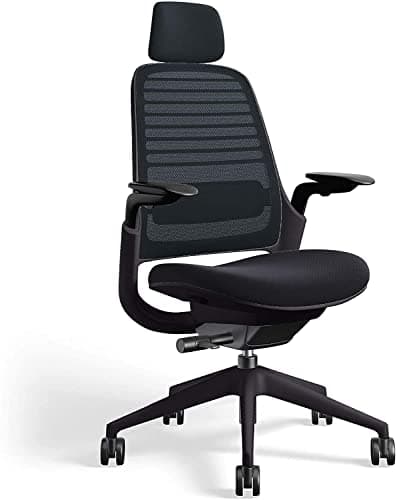
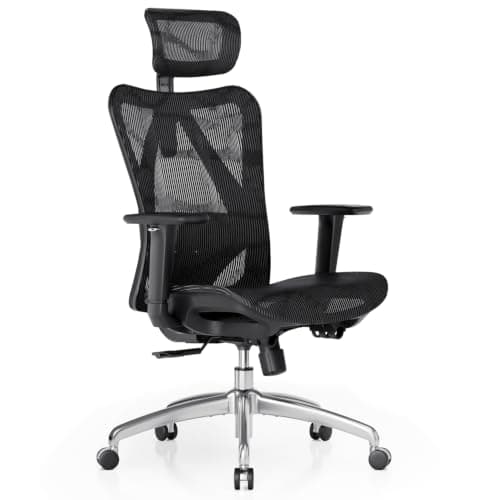
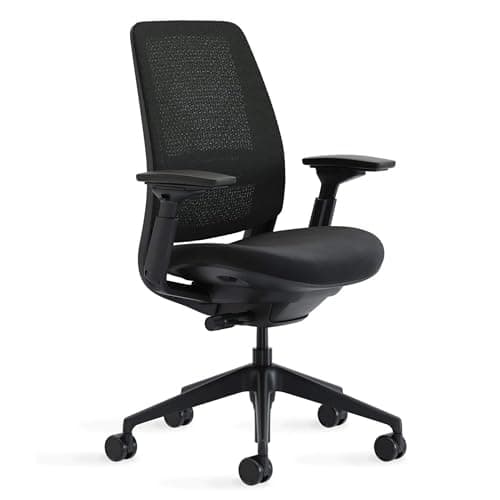
Buy the office chair. If what you actually want from a gaming chair is the tall back and the headrest, buy the Steelcase Series 2 — it is the taller-backed Steelcase at 38 to 42.5 inches overall against the Series 1's 36.5 to 41.25, it is rated to 400 lb, it carries a 12-year warranty, and Steelcase publishes an SCS Indoor Advantage Gold emissions certificate for it. If the budget is a gaming-chair budget rather than a Steelcase budget, the Ticova is the closest honest match: high back, adjustable headrest, adjustable lumbar and 3D arms. The two categories are not as far apart as either side claims — but they fail in different places, and only one of them tells you what you are breathing.
Where the two categories are actually the same
The durability argument is largely settled, and it does not favor either side. The North American performance standard for office seating is ANSI/BIFMA X5.1, and gaming-chair makers test to it too. CORSAIR's own explainer describes X5.1 as covering strength, durability, stability and safety across eleven tests and over one million cycles of overall testing — among them 270 lb placed on the chair and swiveled 120,000 times, and 240 lb loaded onto the seat and tilted back and forth 300,000 times. The European standard, EN 1335, goes further in one specific direction: alongside safety requirements (Part 2) and test methods (Part 3), its Part 1 sets dimensional requirements for chair types A, B and C, measured with a standardized seat mock-up to ISO 24496.
So "gaming chairs are not built to a standard" is not true of the brands that publish one. Mechanically, a good gaming chair is a task chair with a different shell: same gas lift, same five-star base, same casters, same class of tilt mechanism. If you are here because you read that gaming chairs collapse, that is a cheap-chair problem rather than a gaming-chair problem — and our sinking-chair page covers the one failure that actually recurs across both categories.
Where they genuinely part company
1. The seat pan — bolsters versus a flat, adjustable pan
This is the real difference and nobody markets it. A racing-style gaming seat has raised side bolsters, because it is styled on a bucket seat built to hold a body in place through corners. At a desk you do not want to be held in place: you want to be able to shift, cross a leg, turn to a second screen. OSHA's computer-workstation guidance and Cornell's seated guidelines both describe a seat that supports the thighs with clearance behind the knee — which a bolstered pan narrows rather than supports.
The office-chair side also adjusts the one dimension gaming chairs almost never do. Seat depth. Steelcase publishes 15.5 to 17.75 inches of seat depth on the Series 1 specification table, with seat height 16.5 to 21.5 inches and a seat width of 19.5 inches. Those are fit numbers for a body, and we could not find an equivalent published set for a gaming chair.
2. The emissions certificate — and this is the one that matters here
You sit inside a chair for forty hours a week in a room you probably do not ventilate much. Steelcase publishes an SCS Indoor Advantage Gold certificate (SCS-IAQ-04139) covering its seating, plus BIFMA LEVEL 3 and a published Environmental Product Declaration. Branch prints "Certified Greenguard Gold for low VOC emissions" on three of its chair pages. We looked for the equivalent document from the gaming-chair brands and could not find a published VOC or emissions certificate for a gaming chair — that is an absence of evidence rather than evidence of a problem, and we treat it as exactly that. But for the buyer this site is built for, an absent certificate is itself a decision.
It compounds with upholstery. Gaming chairs are overwhelmingly sold in PU or PVC-coated faux leather, which is a different material question from a knit or mesh back — we work through what the two coatings are, and which one needs plasticizers, in faux leather office chairs.
3. Recline and the headrest — where the gaming chair wins
Credit where it is due: a deep recline with a headrest is genuinely useful if you lean back to think, read or watch something, and most mid-back task chairs cannot do it. That is a real want, not a marketing invention. The answer is not to pretend otherwise — it is to buy that feature from a chair that also adjusts. The Series 1 headrest build fits Steelcase's own headrest, which adjusts 3.25 inches vertically and is designed to support the head both upright and reclined; the Ticova pairs a high back and adjustable headrest with an adjustable lumbar pad at a fraction of the price.
The comparison, by what each side publishes
| Decision | Typical gaming chair | Ergonomic office chair |
|---|
| Durability standard | ANSI/BIFMA X5.1 and/or EN 1335 where the brand publishes it | ANSI/BIFMA X5.1; Steelcase publishes a dated X5.1 and X5.11 certificate at 400 lb |
| Seat pan | Bolstered bucket shape; depth usually fixed | Flat pan; Steelcase publishes 15.5-17.75 in of seat-depth adjustment |
| Lumbar | Often a strap-on pillow | Height-adjustable pad or a flexing back (Branch lists 14 adjustment points on the Pro) |
| Back height | Tall by default, with headrest | Mid-back by default; the Series 2 is 38-42.5 in, and headrest builds exist |
| Emissions certificate | None we could find published | SCS Indoor Advantage Gold (Steelcase) or GREENGUARD Gold (Branch, three models) |
| Warranty | Commonly 2-5 years | Steelcase 12 years; Branch 7 years on the Pro and Verve, 5 on the Daily |
| Upholstery | PU or PVC faux leather, or a gaming fabric | Knit, mesh or wool-blend; vegan leather on some models |
Who should actually buy a gaming chair
Three cases, stated plainly, because pretending there are none would be dishonest.
- You want the look. It is your room. A chair you like sitting in gets sat in properly, and that beats a beige chair you resent.
- You recline for hours and type for minutes. If the desk is mostly for play, a deep recline with a headrest and a footrest is the shape that fits that, and a task chair is not.
- You are at the extremes of the size range. Some gaming lines publish stature and weight ranges per size, which is fit data the budget task-chair tier rarely gives you. Our big and tall and short-stature pages cover the office side of that.
For everyone else — eight hours a day, keyboard work, a room you sleep near — the office chair is the better instrument, and the certificate is the tiebreaker. If your filter is the document rather than the shape, start at GREENGUARD-certified chairs.
Choosing between them in four checks
1. Count your typing hours, not your gaming hours
Upright keyboard work is what a task chair is shaped for. If most of your week is upright and at a keyboard, that is the chair to buy, and recline is a bonus you will use occasionally.
2. Ask whether the pan adjusts
Seat depth is the adjustment that decides whether the front edge presses into the back of your knees. A fixed bucket pan cannot be fitted to a femur; a published depth range can.
3. Ask for the emissions document by name
Not "eco-friendly materials" — a certificate. GREENGUARD Gold is verified at UL SPOT; SCS Indoor Advantage Gold is verified in the SCS Certified Green Products Guide. If neither registry has the chair, treat the materials as undocumented.
4. Compare the warranties as cost per year
A 12-year warranty on a chair that costs twice as much as a 3-year chair is the cheaper chair. We do that math properly in how long office chairs last.