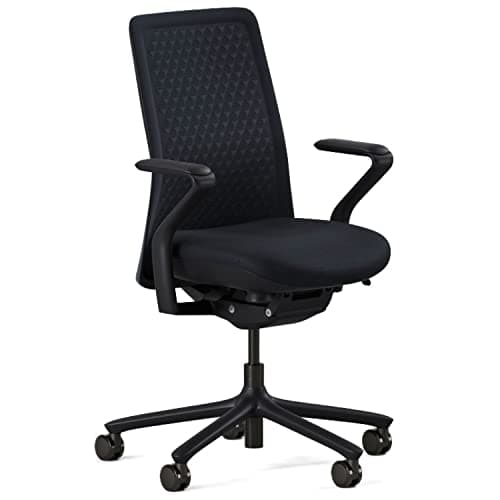
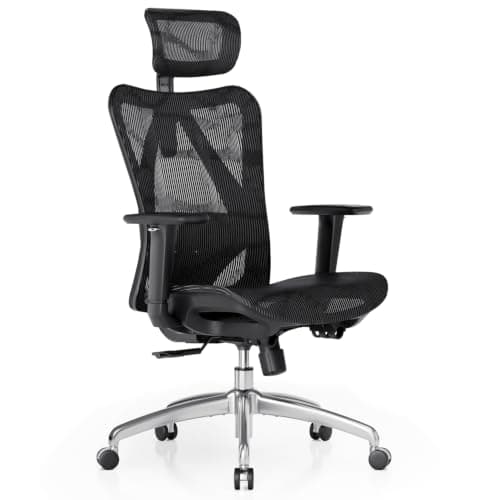
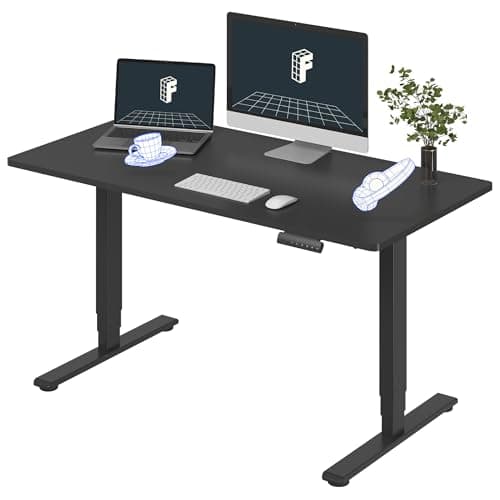
Buy the chair first if your desk is already at roughly your seated elbow height, or if you sit for most of the day in something with no lumbar adjustment. Buy the desk first if your desk is noticeably too high — which for most people it is — because no chair fixes a surface you have to reach up to. Two measurements decide it, and they take a minute.
The two numbers
One: your seated elbow height. Sit with your feet flat and your shoulders relaxed, bend your elbows to about 90 degrees, and measure from the floor to the underside of your forearm. Most people land between 25 and 28 inches. Standard fixed desks are 29 to 30.
If your number is well below your desk height, the desk is the problem. You are either raising the chair until your feet dangle or reaching up and extending your wrists, and the best chair in the world will not change either. Buy the desk.
Two: your daily desk hours. Under about four hours, the chair matters relatively more, because you are unlikely to be alternating much anyway and comfort in the one position dominates. Six or more, the ability to change position starts to outweigh the quality of any single position.
What each one actually fixes
An ergonomic chair fixes support. Adjustable lumbar puts a surface behind the curve of your lower back so it does not flatten. Adjustable arm height takes the weight of your arms — roughly a tenth of your body mass — off your neck and shoulders. Seat height and depth set your legs and circulation. These are real, and a chair with none of them is a stool with a back on it.
A sit-stand desk fixes height and duration.It puts the surface at your elbows in both positions, and it lets you leave any one position before it starts to hurt. Mayo Clinic's guidance on prolonged sitting and OSHA's ergonomics material both treat sustained one-position loading as the risk factor — which is the thing only the desk addresses.
Note what neither fixes: your screen height. That is a monitor arm and it is the cheapest of the three by a wide margin. If your neck is the complaint rather than your back, buy that first and neither of these — the reasoning is in standing-desk neck pain.
The case for the chair, put fairly
Most people who buy a standing desk still sit for the majority of their day. That is not a failure of discipline, it is what the research-supported pattern actually looks like — alternate, do not maximize. Which means the chair is carrying more hours than the standing is, and a bad chair for five hours is worse than a good chair for five hours regardless of what the desk does.
There is also a floor effect. Going from no lumbar support to adjustable lumbar support is a larger change than going from a good chair to a slightly better one. If you are currently in a dining chair or a £40 mesh chair with a fixed back, the first £200 you spend on seating buys more than the second £600 will. The budget chair roundup is where that floor sits.
The case for the desk, put fairly
The desk is the only one of the two that changes the structure of your day rather than the comfort of one position. It also fixes the seated half — a fact that gets lost because "standing desk" is a bad name for a desk whose main advantage is that it goes down.
And there is a behavioral point. A good chair is passive: you buy it, you sit in it, nothing else changes. A sit-stand desk with presets creates a prompt several times a day, and that prompt is what actually produces the movement. Whether that matters to you is a self-knowledge question, and it is worth being honest about before spending.
What we would do at three budgets
- Small. A monitor arm and a lumbar cushion, and set your existing chair and desk properly using the self-assessment. This costs very little and fixes more than people expect.
- Medium. One of the two, chosen by the elbow-height test. Too-high desk: buy the desk, or a bare frame under your existing top. Desk already about right: buy the chair.
- Larger. Both, and buy the desk first — because the chair you need depends partly on the desk height you settle at, and doing it the other way round means re-adjusting everything twice.
The answer for most people
Measure your elbow height. If it is more than about two inches below your desk, the desk wins and it is not close. If your desk is already close to right and you are sitting in something with no adjustment, the chair wins. If neither is obviously true, buy the chair — because the hours are on its side, and a sit-stand desk you never raise is an expensive fixed desk.