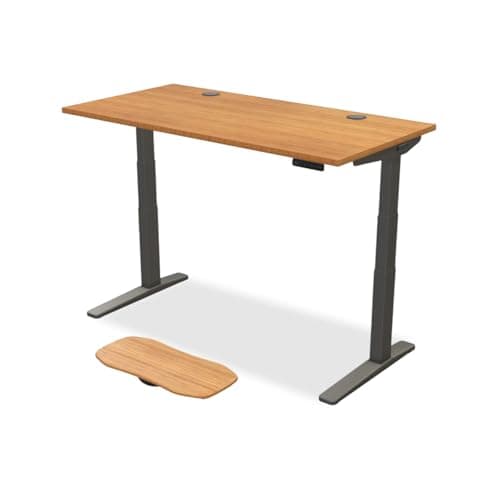
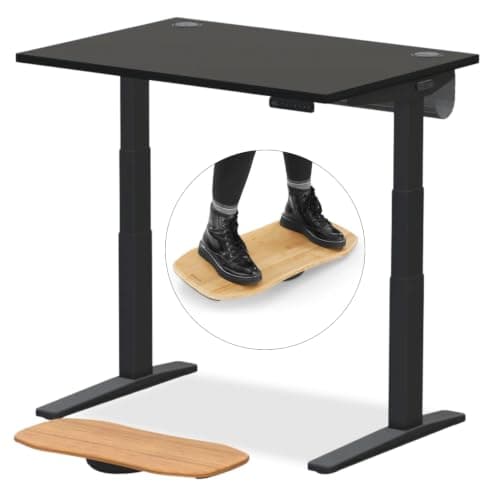
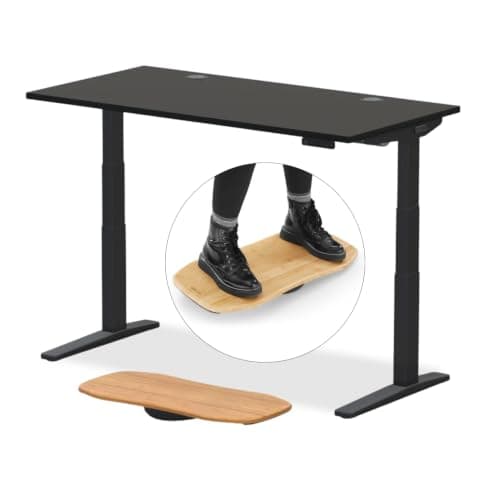
Buy the UPLIFT V3 with a laminate top. That sentence will read backwards to anyone who has spent an afternoon shopping for a "non-toxic" desk, because bamboo is the top everybody assumes is the healthy one. But UPLIFT publishes a GREENGUARD Gold document for its laminate desktop line and publishes nothing of the kind for its bamboo — and on this site a certificate you can go and read beats a material that merely sounds better. The laminate also happens to cost less than the bamboo at the same size, which makes this one of the few times the honest recommendation and the cheap one are the same object.
What the V3 actually is
A two-leg, height-adjustable desk with a motor in each leg, sold as a frame plus a desktop you pick from a long list of materials. UPLIFT states a height range of 22.6 to 48.7 inches, a lift capacity of 355 pounds, and a 15-year warranty covering the desktop, frame, motors and electronics, extendable to 25. Those are manufacturer figures — we did not measure them, and we say so on every page — but they are published figures rather than marketplace copy, which is a meaningful difference when you are comparing against listings that quote nothing at all.
The height range is the number worth stopping on. Nearly 26 inches of travel brackets both a low seated height and a standing height tall enough for most people, which is the whole point of a sit-stand desk and the thing budget frames quietly compromise on. If you are on the short side or the tall side of average, run your own numbers through our standing desk height calculator before you order any desk — the maximum height gets all the marketing attention and the minimum height is what actually fails people.
UPLIFT also states the V3 is tested for structural integrity against ANSI/BIFMA X5.5-2021 and for ergonomic compliance against G1-2013. Read that carefully: it is UPLIFT saying its desk meets those standards, not a third-party certification mark issued against them. Vari, by contrast, states it carries the UL BIFMA Performance Certification mark — an independently issued mark rather than a self-declaration. Both claims can be true and they are not the same claim, and our BIFMA explainer exists because that distinction is where most desk listings get away with murder.
The certificate is on the laminate. It is not on the bamboo.
Here is the part of this review that matters more than everything else combined.
UPLIFT publishes a document titled "Greenguard-Gold Certified Laminates" stating that all of its laminate desktops are GREENGUARD Gold certified. GREENGUARD Gold is the stricter of the two GREENGUARD tiers and is the one written into school and healthcare specifications, so if a low-emission surface is your deciding factor, this is the tier you want. The construction underneath it is a 45 lb density E-1 rated particleboard core wrapped in thermally-fused melamine, with 3 mm PVC edge banding, at one inch thick.
UPLIFT's bamboo desktops get a different pitch entirely: sustainably harvested bamboo, a UV-cured finish, one inch thick, the same 15-year warranty. What they do not get is a GREENGUARD claim, and UPLIFT does not pretend otherwise. That silence is, oddly, the most trustworthy thing about the brand. Most makers let one product's certificate cast a warm glow over an entire catalog; UPLIFT tells you which line the mark sits on and leaves the other line to argue for itself on material grounds.
So the two tops are two different kinds of argument. The bamboo is a materials argument — a solid grass surface with no adhesive-bound composite core, which sidesteps the formaldehyde question rather than certifying against it. The laminate is a registry argument — an engineered-wood core that has been tested and documented against emission limits. Neither is dishonest. They just answer different questions, and the one you are asking decides which top goes in the cart.
What UPLIFT's document does not say
We are not going to oversell this. Three limits, stated plainly:
- It is a line-level claim, not a SKU-level one.UPLIFT's PDF names the testing standards behind GREENGUARD Gold — ASTM D-5116 and D-6670, the ISO 16000 series, Germany's Blue Angel program — but it does not print a certificate number tied to a specific desktop size and finish. Vari's certification table does exactly that, per SKU, which is why our Vari Classic review still calls Vari the most granular disclosure in the category.
- The Amazon listing carries none of this.The V3 laminate listings we link below do not use the word GREENGUARD anywhere in the title or the bullets. The claim lives on upliftdesk.com, not on the marketplace page, so a reader who only ever sees the Amazon listing would never know the certificate exists. That is UPLIFT's problem to fix, not yours, but you should know the claim is not printed where you are buying.
- Verify it yourself, once. GREENGUARD certificates live in the public UL SPOT registry, and looking one up takes about four minutes. Our GREENGUARD explainerwalks through it. Do it once for any desk you are about to spend several hundred dollars on and you will never read an "eco-friendly" product page the same way again.
Bamboo or laminate: how to actually choose
Ask yourself one question and the answer falls out.
"Do I want a document, or do I want to avoid composite wood?"
If you want the document — because you are furnishing a room for someone with asthma or a chemical sensitivity, because a spec sheet is what you trust, or because you have been burned by a listing that said "eco" and meant nothing — take the laminate. It is the certified line, and it is the cheaper of the two at matching sizes.
If you want to avoid engineered wood as a category, the laminate does not get you there, because a certified particleboard core is still a particleboard core. Then the bamboo is the better buy, and you are trading a registry entry for a material with nothing bound into it. And if you want to skip the compromise entirely, the honest answer is neither: buy a bare frame and a solid wood top, which is the only genuinely composite-free route and usually costs less than either UPLIFT configuration.
Either way, give a new desk its break-in period. Even a Gold-certified top emits something in its first days out of the carton, and 72 hours of airflow before it enters the room you work in removes a disproportionate share of the total for free.
Where the V3 costs you
This is a premium-tier desk and it does not disguise that. For the money you get a frame, a certified or solid top, wire management and a 15-year warranty. You do not get a drawer, you do not get integrated power, and you do not get an app. Desks at a third of the price offer all three — our desks with drawers roundup is full of them — and they publish nothing about what their tops are made of. That is the trade, stated without spin: UPLIFT sells documentation and warranty length, and charges for both.
The other cost is configuration fatigue. UPLIFT sells over 200 desktop combinations across six material categories, and the Amazon listings are a narrow slice of that. If you want a finish or a size that is not listed on the marketplace, you are ordering direct — which is fine, just be aware that the Amazon route trades choice for convenience.
The desk most buyers weigh against the V3 is the Branch Duo, and the two separate on three published numbers rather than on feel: minimum height, load rating and whether anyone certified the surface. That comparison is Branch vs UPLIFT.
How it compares to the desks we already rank
Against the best standing desks overall, the V3 is not the value pick and never will be. The FlexiSpot E6 gives you a very good dual-motor frame for substantially less, and our FlexiSpot E6 review is straightforward about the catch: FlexiSpot publishes no emissions certificate for its standard laminate top at all. That is the entire gap between the two desks. If certificates are noise to you, buy the E6 and spend the difference on a monitor arm.
Against Vari, it is closer and more interesting. Vari publishes per-SKU rows and holds an independently issued BIFMA performance mark; UPLIFT publishes a line-level emissions document and a longer warranty, with a wider height range and a higher rated capacity. If your priority is the most granular certificate on the exact desk you receive, Vari. If it is the longest warranty and the widest adjustment range with a real emissions document behind the top, UPLIFT. Both belong on our certified desks page, and both are a different species from the undocumented majority. The full head-to-head, document by document, is UPLIFT vs Vari.
Who should buy it, plainly
Buy the UPLIFT V3 laminate if a checkable emissions document is your first filter, you want the adjustment range and the warranty, and you can live without storage features. Buy the bamboo instead only if avoiding composite wood matters more to you than holding a certificate — and accept that you are paying more for the less-documented top. Buy neither if price is the deciding factor, or if what you actually want is a surface with nothing engineered in it, in which case a frame and a solid slab beats both of these for less money.