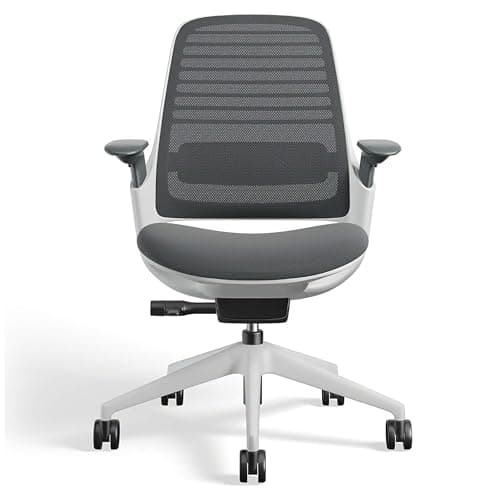
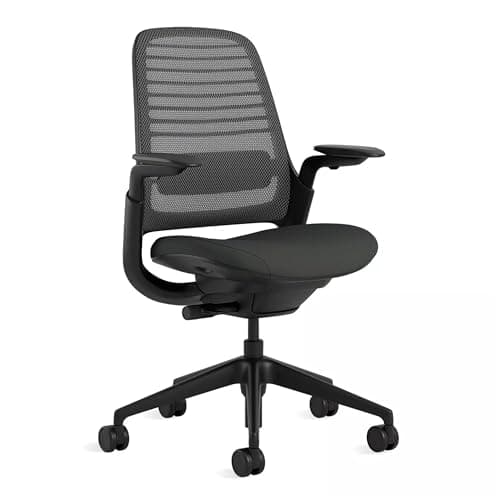
The Steelcase Series 1 is the chair we send people to when they want the decision made by documents rather than by adjectives. Steelcase publishes a dated compliance certificate stating the chair supports users up to 400 lb, a cut sheet that names BIFMA LEVEL 3, CAL 117 and SCS Indoor Advantage Gold, an Environmental Product Declaration, and a 12-year warranty that covers parts and labor around the clock. No other chair we rank comes with that much paper. The catch for this site's reader is small but real: the emissions certificate is SCS Indoor Advantage Gold, not GREENGUARD. Same test method, different certifier, different registry — and if you go looking for it in UL SPOT you will not find it there.
What Steelcase actually publishes
Most chair reviews describe how a chair feels. This one describes what the manufacturer is willing to put its name to, because feel is personal and a certificate is not. For the Series 1 there are four documents that matter, all hosted on Steelcase's own domain and all listed in the sources at the bottom of this page.
- The Product Compliance certificate.Certificate #L2132, dated 8 January 2024 and signed by Steelcase's Director of Global Testing, states that Series 1 seating was tested to ANSI/BIFMA X5.1 (general-purpose office chairs), X5.11 (large-occupant chairs) and X6.1 (educational seating), plus 16 CFR Part 1640 and California TB 117-2013 for standard fabrics. It says the chairs support users up to 400 lb "with no loss of performance", that testing was done in ISO 17025 accredited labs, and it carries Steelcase's own footnote against X5.11: "Meets all criteria except the minimum seat width." We put that footnote in the ranking on our big-and-tall page; it belongs here too.
- The cut sheet. Item #25-0000121, February 2025. Under Certifications it prints, verbatim: BIFMA Compliant, BIFMA LEVEL 3, CAL 117, SCS Indoor Advantage Gold – Furniture, Environmental Product Declaration. Under Warranty: weight-tested to 400 lb, 12-year, multi-shift, 24/7, both parts and labor. It also gives the numbers a listing usually garbles: 36.5 to 41.25 in overall height, 27 in wide, 29 lb.
- The Seating Specification Guide.February 2024, the dealer document. This is where the adjustment ranges live, and where Steelcase says in plain words that the "back frame and seat shell are plastic". The next section is built from it.
- The warranty. The Americas Limited Lifetime Warranty is non-transferable and runs to the original end-use customer from the date of delivery. It also contains the clause every marketplace buyer should read before checkout, which we get to below.
Indoor Advantage Gold is not GREENGUARD — and why that is fine
The site's reader usually arrives with one question: is it GREENGUARD certified? For the Series 1 the honest answer is no, and it is worth being precise about what that does and does not mean, because our own product notes used to hedge it as "GREENGUARD or low-emission certification" and that hedge is now retired.
GREENGUARD is UL Solutions' low-emission program; its public registry is UL SPOT, which our GREENGUARD explainerwalks through. SCS Indoor Advantage Gold is the equivalent program from SCS Global Services. According to SCS's own program page it aligns with ANSI/BIFMA M7.1 and X7.1 — the same furniture chamber-emissions method GREENGUARD tests to — and with California's CA 01350, screening for 35 individual VOCs including formaldehyde. It requires annual reviews to keep the certificate, it is recognized as a low-emitting-materials credit under LEED, WELL, BREEAM and the Living Building Challenge, and certified products are listed in the SCS Certified Green Products Guide rather than in SPOT.
Steelcase's FY2025 SASB index says the quiet part out loud: "most Steelcase products, globally, have achieved Indoor Advantage Gold certification", tested to ANSI/BIFMA M7.1-2011 (R2021) and X7.1-2011 (R2021). In other words Steelcase chose SCS as its certifier for emissions and BIFMA LEVEL and Declare for the rest. The chair has been through the chamber; it just has a different logo on the paperwork.
One honest limit.SCS's product-guide pages are rendered by script and return nothing to an automated fetch, so we could not open a certificate number for the Series 1 ourselves. What we can say is that Steelcase names the certification on the cut sheet and in its investor disclosure, and that the SCS guide is public — the buyer's guide below tells you how to run the search. We are not going to claim a lookup we did not complete.
The chemistry position, from Steelcase's own filing
The same SASB index contains two sentences that matter more to this site's reader than any comfort claim. First: "Steelcase has a corporate policy to prohibit the use of any type of flame retardant unless critically required to meet a flammability or electrical safety standard", with a toxicological assessment required before any exception is approved. Second: Steelcase "has implemented a plan to reduce and ultimately eliminate the presence of any per- and polyfluoroalkyl substance (PFAS) in its products."
Read those alongside the certificate's CAL 117 line. TB 117-2013 is the smolder-resistance test, which — as our flame-retardants page explains — can be met without treated foam. A policy statement is not a per-chair lab result, and the seat is still foam in a fabric cover, so the right move is the one we recommend for every chair: tip it over before assembly and read the added-flame-retardant statement on the law label. But a manufacturer that publishes a prohibition policy, a PFAS elimination plan and a third-party emissions certificate is in a different category from the marketplace brands that publish nothing, and this is the whole reason the Series 1 outranks cheaper chairs with more levers.
The adjustments, with Steelcase's numbers
Everything below is from the February 2024 specification guide, not from an Amazon spec table. The distinction matters: the carpet-caster listing prints a 300 lb figure in one table and a 400 lb figure in its safety information, and the Steelcase document is the one that wins.
- Seat height adjusts 5 in, from 16.5 to 21.5 in, on a pneumatic cylinder. A short-range cylinder (14.75 to 17.75 in) and a tall-range cylinder (17.25 to 22 in) exist as dealer options; the Amazon listings we checked are the standard range. If you are under about 5 ft 3 in or over about 6 ft 3 in, run your numbers through our height calculator before assuming the standard cylinder fits.
- Seat depth slides 2.25 in, from 15.5 to 17.75 in, by pulling a handle. This is the adjustment that stops the seat edge pressing behind the knee, and it is why the Series 1 leads our back-pain seating page.
- Lumbar height adjusts 2.25 in, sitting 6.5 to 8.75 in above the seat, by sliding the support on the 3D Microknit back. Adjustable lumbar is standard on the Microknit back; the Air back version has no lumbar adjuster at all, so do not assume it from the model name alone.
- Arms move in height (4.5 in, from 6.5 to 11 in above the seat), width (2 in each side, 4 in overall), depth (2 in) and pivot (40° inward and outward). Height-only arms and an armless build exist in the dealer catalog; every Amazon listing we checked decodes to the 4D arms.
- Reclineruns from 100° to 122° between seat and back, on a weight-activated mechanism with a three-position comfort dial: weight-activated, a boost setting that Steelcase says adds 20 percent more tension, and an upright lock. Cornell's guidance puts the best seated posture at a reclined 100 to 110°, which this range covers with room to spare.
- Casters are hard dual-wheel as standard, made for carpet. Soft roll-control casters are the hard-floor option, with an internal brake that engages when the chair is unloaded so it does not roll away as you stand. Glides are a third option.
- Size. Seat width 19.5 in, back width 17.25 in, back height 21.5 in from the seat, overall footprint 23.5 to 27 in wide and 21 to 23.75 in deep. Seat pan angle 2°.
What the Amazon listing actually is
Steelcase configures chairs by style number, and the Amazon listings carry that number. The carpet-caster Graphite chair we rank first lists its part number as 435A00-5T29-5S25-6205-4ARM-LUM-CC. Decoded against the cut sheet's color schemes and option list: 435A00 is the Series 1 chair, 5T29 is Graphite 3D Microknit, 6205 is the black frame, 4ARM is the 4D arms, LUM is the adjustable lumbar and CC is carpet casters. The listing's own description confirms it: adjustable seat depth, "fully adjustable arms (raise up and down, pivot in and out, shift forward and back and side to side)", adjustable lumbar, pneumatic seat height, weight-activated recline with lock, and wheels for carpet. The hard-floor Graphite build ends in -HF, and its frame code is 6053 — Seagull, the light frame — rather than black.
Two more things the listing tells you if you read past the bullets. It carries Amazon's Climate Pledge Friendly badge citing BIFMA LEVEL 3, which matches the cut sheet. And it ships from and is sold by Pattern. That name matters: Steelcase's own where-to-buy page says it partners "with Pattern, Amazon's leading authorized third-party seller, to become the exclusive authorized seller of Steelcase products on the platform." Steelcase's warranty reserves the right to reject claims on chairs bought from unauthorized sellers, "including unauthorized Internet sites", so the sold-by line on the day you buy is not a detail. If it does not say Pattern or the Steelcase brand store, stop and check.
Casters, headrest, Series 2: the three builds we also rank
Amazon groups the Series 1 into one variation family — Color, plus a Style selector for Carpet Casters, Hard Floor Casters and Headrest included — so you can reach every build from any listing. We rank three of them separately because they answer three different questions.
Hard floors. The right answer for wood, tile or laminate is the hard-floor buildwith Steelcase's soft roll-control casters, not a set of aftermarket wheels pushed into a carpet chair. Its part number confirms the full 4ARM-LUM configuration. At the time of writing the Graphite hard-floor listing carried a premium over the carpet chair and a two-to-three-week lead time, while a Tangerine hard-floor listing in the same family sat at the base price but printed only the bare style number — so if you go for the cheaper one, confirm the arms and lumbar in the photos before you order. The buy buttons below show the live figures.
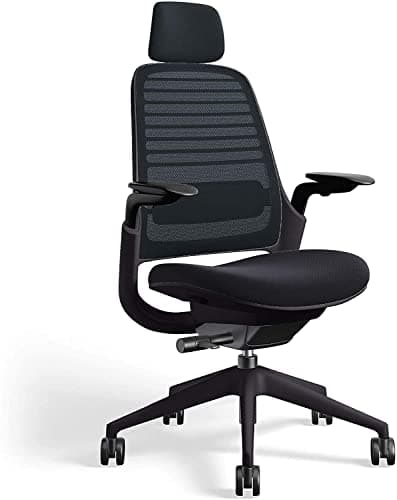
Headrest.Steelcase's headrest is field-installed, adjusts 3.25 in vertically and is designed for both upright and reclined postures. The headrest-included buildsaves you the separate headrest listing and the install, and its Amazon spec block is the only one that quotes Steelcase's dimension table number for number. It also adds a lead time and a premium. Read our neck-pain seating page first: a headrest supports a reclined head, and it will not fix a monitor that sits too low, which is the more common cause.
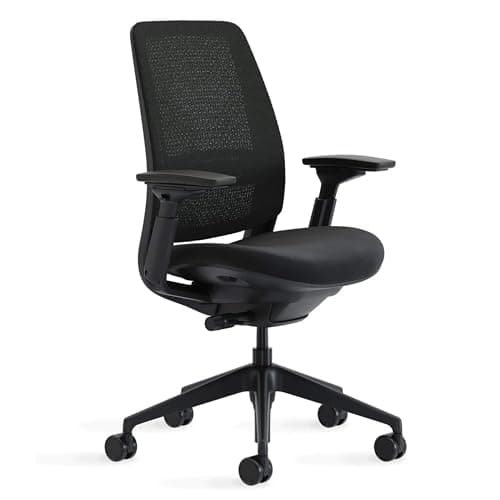
Series 2. The most-searched comparison is Series 1 versus Series 2, and the documents make it short. The Series 2cut sheet lists the same 400 lb capacity, the same 12-year multi-shift warranty, the same 4D arms and adjustable lumbar on its Microknit and upholstered backs, and the same SCS Indoor Advantage Gold and EPD. What changes is the back — Steelcase's Air LiveBack, a molded geometric pattern that flexes in two directions — and the height: 38 to 42.5 in overall against the Series 1's 36.5 to 41.25 in, at 36 lb rather than 29. If the Series 1 back stops short of your shoulder blades, that is the reason to pay more. If it does not, the extra money buys a shape, not a document.
Where it falls short
Steelcase's own guide says the back frame and seat shell are plastic. That is normal at this price and irrelevant to the load rating, which is tested, but it is the reason the chair weighs 29 lb and the reason it does not feel like the aluminum-framed flagships that cost several times more. The seat is foam over a plastic shell, which puts it on the foam side of our mesh-versus-foamargument even though the back is a knit. Seat foam is the component that ages first on every chair, and Steelcase's 12-year coverage of foam is the strongest answer to that we know of, but it is still foam.
The seat is 19.5 in wide, which is why Steelcase footnotes its own X5.11 result. The chair has been tested to large-occupant loads; it has not been built to large-occupant width. The Amazon builds are the standard-range cylinder only, so short and tall sitters cannot get the dealer-only short and tall cylinders through this channel. And the specialty builds — hard floor, headrest — showed multi-week lead times when we resolved them, which the base carpet chair did not.
Finally, price. The Series 1 sits in the band where a real certificate starts to be normal, well above the SIHOO M57 and the rest of our budget picks, and well below the Aeron. Everything above it costs more for design and materials; almost nothing below it costs less with the same documents. That is the whole value case, and it is a strong one only if the documents are what you are buying.
Who should buy it
Buy the Series 1 if you want a chair whose capacity, emissions and durability claims each come with a document you can open, if you sit somewhere between about 5 ft 3 in and 6 ft 3 in on the standard cylinder, and if you would rather spend on twelve years of parts-and-labor coverage than on a headrest and a fifth arm axis. Buy the hard-floor build if your floor is hard; buy the Series 2 if the back is short on you. Do not buy it if your deciding filter is specifically the GREENGUARD mark — the chairs that carry that one are on our GREENGUARD-certified chairs page — or if you need a seat wider than 19.5 in, in which case the X5.11 footnote is telling you to keep reading. Our main chair roundup shows where it stands against the whole field.