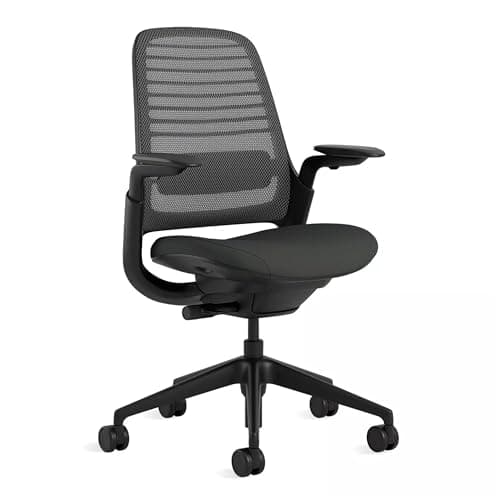
Buy the Steelcase Series 1. Its published compliance certificate names ANSI/BIFMA X5.11 — the large-occupant seating standard — and states plainly that Series 1 chairs support users weighing up to 400 lb, tested in ISO 17025 accredited labs. It is the only chair here whose capacity claim comes with a document, a date and a signature. It also carries one honest asterisk, which we put in the ranking rather than in the footnotes.
The standard almost nobody mentions
Search "big and tall office chair" and you will be shown a wall of listings claiming 350 lb, 400 lb, even 500 lb capacities. Almost none of them name a test. There is a test, and knowing its name is the most useful thing on this page.
Office seating in the United States is evaluated against the ANSI/BIFMA standards. The ordinary one, X5.1, covers general-purpose office chairs and is written around an occupant with a corporal mass of up to 275 lb — the 95th percentile male. If you weigh more than that, a chair certified to X5.1 has not been tested for you. It may well hold; it simply was not assessed at your load.
The one that was is ANSI/BIFMA X5.11, "General Purpose Large Occupant Office Chairs". It is broadly the same battery of tests as X5.1, rebuilt around a 400 lb individual — the 99.5th percentile male — and it raises the loads accordingly. Where X5.1 runs its drop test at 225 and 300 lb, X5.11 runs 250 and 350. Where X5.1 cycles the swivel under a 250 lb load, X5.11 uses 400. Where X5.1 drops a 125 lb bag onto the seat, X5.11 drops 200. It also adds a structural durability test X5.1 does not require, and — this is the part that matters below — it requires a minimum seat width of 22 inches for a chair to be called a large-occupant chair at all.
So "big" and "tall" are two different specifications. Big is a load question, answered by X5.11 test loads. Tall is a geometry question, answered by seat height, seat depth and back height. A chair can be excellent at one and indifferent to the other, and the marketing category smears them together.
Where each pick actually stands
- Steelcase Series 1 — documented, with one asterisk.Steelcase's own Product Compliance Laboratory publishes a dated confirmation (8 January 2024) that Series 1 seating was tested to X5.1, X5.11 and the educational-seating standard X6.1, and that chairs support users up to 400 lb with no loss of performance while stools support up to 300 lb. The asterisk is Steelcase's own: against X5.11 the chair "meets all criteria except the minimum seat width". In plain terms it has been tested to large-occupant loads but the seat is narrower than 22 inches. If your requirement is strength, this is the best-documented chair on the page. If your requirement is width, read that footnote twice.
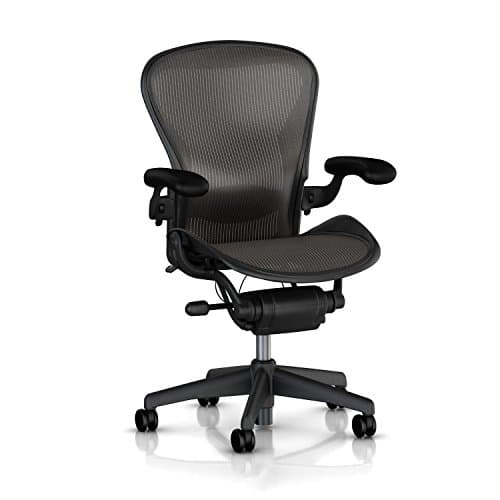
- Herman Miller Aeron — the one that answers it with sizing.Herman Miller publishes an official Size/Fit Reference, current as of February 2026, that does something almost unique in this category: it gives a capacity per size. A-size chairs are tested and warrantied to 300 lb, B-size to 350 lb, and C-size to 400 lb, with a height-and-weight chart running from 4'8" to 6'7" and 90 to 400 lb. For a big-and-tall buyer the C-size is the configuration that matters — and this is exactly why buying an Aeron from a marketplace listing is risky. The size is the specification. Buy the wrong one and you have bought a chair rated 50 to 100 lb below the one you meant to.
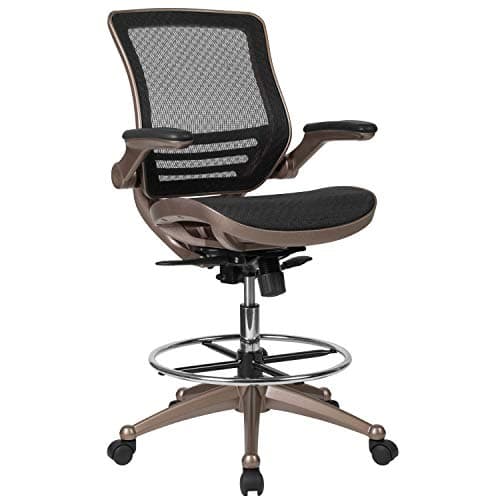
- Flash Furniture Waylon — where the documentation runs out. Flash rates this chair at 250 lb. That is a published number from an established office-furniture brand, and it is also below the X5.1 threshold, let alone X5.11. It is here as the honest boundary of the category: a decent mid-budget mesh chair for a sitter under its rating, and the wrong purchase above it.
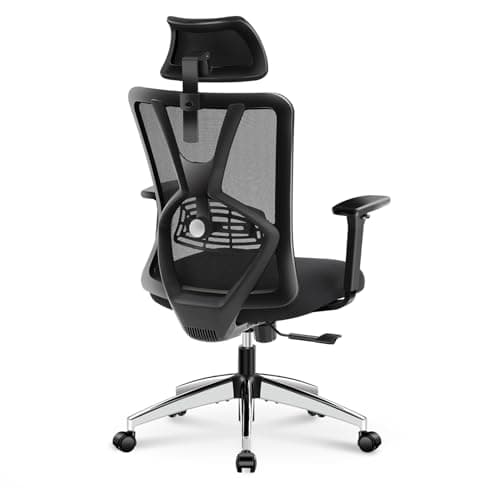
- Ticova High-Back — tall, undocumented on load. The high back and adjustable headrest genuinely help a taller sitter, which is why it appears on this list at all. But no weight capacity, BIFMA test or emissions certificate is published for it. Ranked last, for that reason, and recommended only on the geometry.
Why a 500 lb claim on a listing should make you suspicious
X5.11 tops out at a 400 lb basis because 400 lb is the 99.5th percentile male. A listing advertising 500 or 600 lb is therefore claiming performance beyond the ceiling of the industry standard, with no standard cited and usually no brand to hold responsible. It is not impossible to build such a chair. It is very unlikely that an anonymous marketplace seller has tested one.
The tell is simple and it works every time: ask which standard, which certification body, and which SKU. A manufacturer with a real program answers in one message with a document — as Steelcase does, and as Herman Miller does with its sizing reference. A seller with a marketing number goes quiet or sends a badge image. The same test applies to the structural claims on desks, which is why our BIFMA-certified desks page exists.
The gas cylinder and the base are what actually fail
When a chair fails under load it is rarely the seat pan. It is the pneumatic cylinder, which starts sinking under your weight, or the five-star base, which is where nylon gives way and aluminum does not. Neither part is usually specified on a budget listing. Both are covered by the durability tests inside X5.1 and X5.11, which is the practical reason the standard matters more than the headline number: it tests the whole chair for tens of thousands of cycles, not just whether the frame survives sitting down once.
A twelve-year warranty, which both of the top two picks carry, is the same information in a different form. A manufacturer underwriting a chair for twelve years of multi-shift use has made a costly bet on its own failure rate. That is the most useful uncertified signal available to you, and it is free to read before you buy.
How to buy a chair when you are outside the 95th percentile
1. Decide whether your constraint is load, width or height
These need different answers. Load points you at X5.11 documentation. Width points you at the 22-inch seat requirement inside that standard — and rules out the Series 1 on its own footnote. Height points you at seat-height range, seat depth and back height instead.
2. Ask for the standard, not the number
"What is the weight capacity?" gets you a marketing figure. "Which ANSI/BIFMA standard was this SKU tested to, and can you send the certificate?" gets you either a document or a silence, and both are answers.
3. If the chair comes in sizes, the size is the spec
The Aeron is the clearest case: three sizes, three different published capacities, one product name. Check the letter before you check the price, and be careful with marketplace listings that do not state it clearly.
4. Check the seat height range against your legs, not your height
Tall sitters usually need a higher seat than standard, and a chair whose cylinder tops out too low leaves your knees above your hips, which rotates your pelvis back and flattens your lumbar curve. That is the mechanism our lumbar support page is about. Measure from the floor to the crease behind your knee and compare it with the published range.
5. Remember the emissions question does not go away
A bigger chair is more foam, more fabric and more adhesive in the room with you. Both top picks come from manufacturers that publish low-emission documentation; the budget end of this page publishes none. Verify any GREENGUARD claim yourself at UL SPOT, and see GREENGUARD-certified chairs.