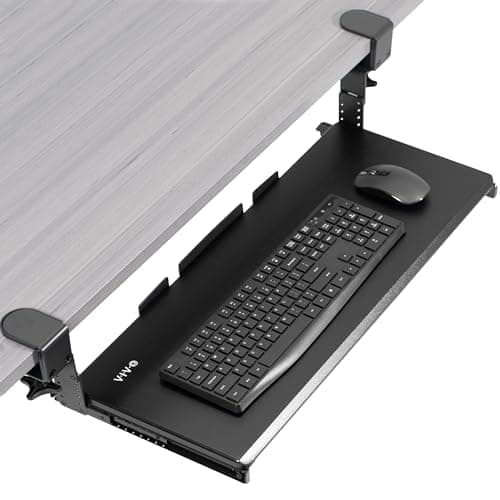
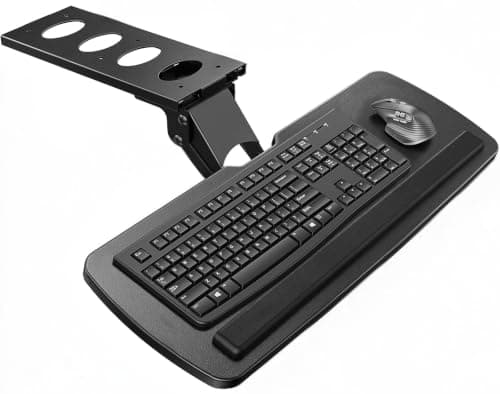
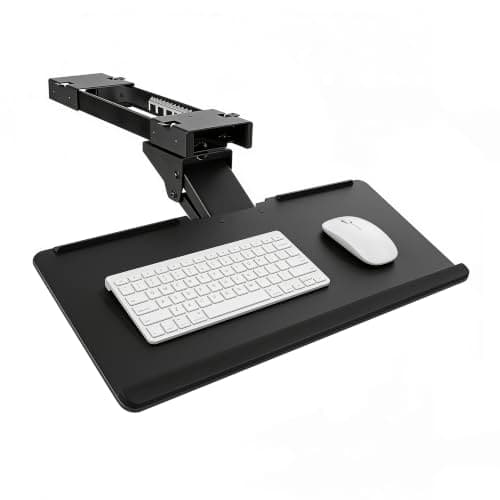
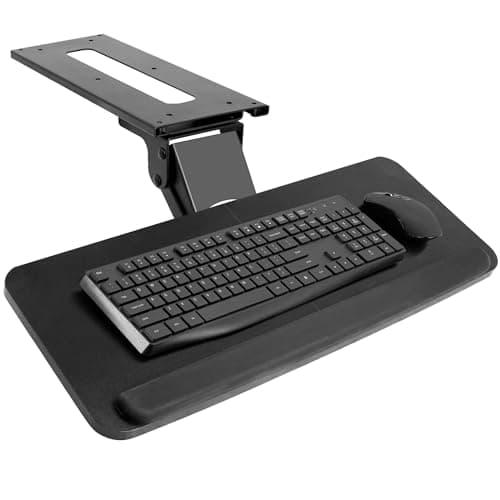
Buy the VIVO platform tray. It gives you the one thing that actually matters — negative tilt, which drops the far edge of the keyboard so your wrists stop bending upward — on a platform wide enough for a keyboard and a mouse together. If you cannot drill into your desk, buy the C-clamp version instead; it costs a little more and leaves no holes.
The problem a tray solves
Standard desks are about 29 to 30 inches high. Seated, most people's elbows sit somewhere between 25 and 28 inches off the floor. That gap is why so many people type with their shoulders slightly shrugged and their wrists bent upward — a posture ergonomics guidance consistently warns against, because extended wrists narrow the carpal tunnel and loaded shoulders ache.
You can fix this three ways: raise your chair (and then your feet dangle), lower the desk (and then your monitor is too low), or drop the keyboard below the desk surface. The tray is the third option, and it is the only one that fixes the wrist angle without breaking something else.
Negative tilt is the whole feature
A flat tray at a lower height helps. A tray with negative tilt — the far edge lower than the near edge — helps considerably more, because it puts your wrists in a neutral or slightly flexed position rather than an extended one. Those little flip-out feet on the back of your keyboard do exactly the wrong thing; they tilt the keyboard toward you and increase wrist extension. Fold them away.
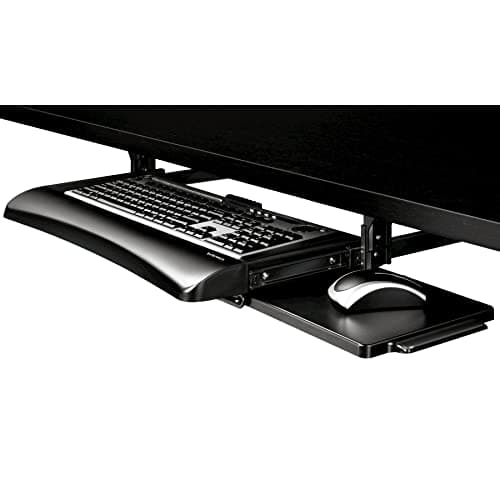
This is why the cheap fixed-height keyboard drawers rank last here. A drawer with no tilt gets your keyboard out of the way, which is a storage benefit, not an ergonomic one. If your wrists hurt, buy tilt.
Clamp or screw
- Screw-mount trays are rigid, cheap and permanent. They need a desk underside you are allowed to drill into and at least three-quarters of an inch of solid material to bite into — a thin veneer over hollow board will not hold.
- C-clamp trays leave no holes and come off cleanly. They need a clear, flat front edge with no apron, lip or drawer in the way, and the clamps take a strip of desktop out of use.
Measure your desk edge before ordering a clamp model. An apron or a front rail is the most common reason one gets returned.
Width, and the mouse problem
Half the point of a tray is defeated if your mouse stays up on the desk, because your mousing arm then works two inches higher than your typing hand — which is exactly the shoulder posture you were trying to fix. Buy a platform wide enough for the keyboard and the mouse, or buy a tray with a swing-out mouse pad.
Left-handed users should look specifically for a rotating mouse platform that swings to either side. Most fixed trays assume a right-handed setup and quietly leave you worse off. A vertical or trackball mouse also helps here, because it reduces how much lateral space you need in the first place.
Trays on a standing desk
Here is the counterintuitive part: if you already have a good sit-stand desk, you probably do not need a tray, because you can set the desk to your elbow height in either posture. Where trays still earn their place on a sit-stand setup is when the desk cannot go low enough for seated work — which is common for shorter users, since many desks bottom out around 28 inches.
The other case is a sit-stand converter. Single-surface converters force your screen and keyboard to the same height; a tray under the host desk restores the split. Our converter roundup flags which models already have two tiers.
Fit the tray, then check everything else
A tray is one of three heights that have to be right. Once the keyboard is at elbow level, the monitor almost always needs to come up to match — that is what a monitor arm is for — and if your feet no longer reach the floor comfortably, add a footrest. Get all three and the setup is genuinely correct; get one and you have moved the problem. The posture guide has the full sequence.
How to buy a keyboard tray
Insist on negative tilt
Downward slope away from you. Without it you have bought a drawer, not an ergonomic fix.
Measure your desk underside
Screw mounts need solid material to bite into and clear space for the rails. Clamp mounts need a flat front edge with no apron.
Get the mouse on the tray too
A keyboard-only tray leaves your mousing arm working at desk height, which is half the original problem left in place.
Check the travel clears your chair arms
A tray hangs a couple of inches below the desk. If your armrests already just clear the desk, they will not clear the tray.
Left-handed? Buy the rotating platform
Fixed trays assume right-handed mousing. A swing-out platform is the only version that works properly on the other side.