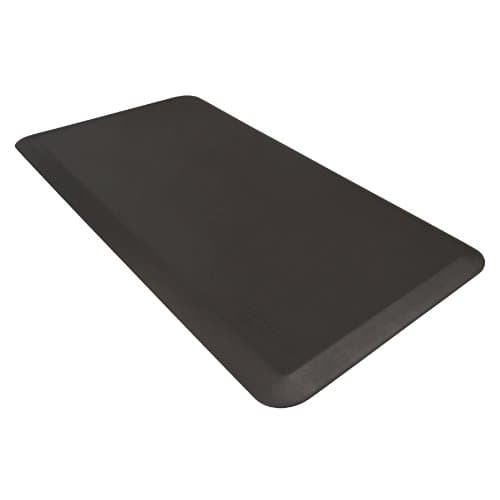
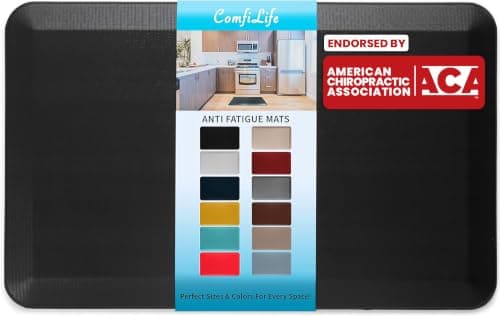
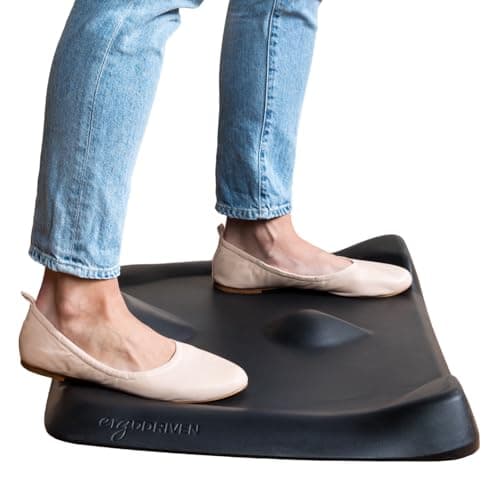
Buy the Ergodriven Topo Mini. It is built from polyurethane (PU) foam rather than PVC, which sidesteps the plasticizer chemistry that makes cheap vinyl mats a materials question in the first place. The GelPro Eco-Pro is the flat alternative, built on a plant-based polyurethane its maker says contains no natural rubber latex, and the ComfiLife is the honest budget PU pick — good material class, no third-party paperwork to back the claim.
PU versus PVC: the choice that actually changes the chemistry
Anti-fatigue foam is mostly one of two plastics, and they are not equivalent. PVC (vinyl) foam is rigid on its own, so it is softened with plasticizers — historically phthalates, several of which appear on California's Proposition 65 list for reproductive harm. Polyurethane does not need that plasticizer step, so a PU mat starts from a lower-concern base. That is the whole reason every mat on this page is PU: it is the material class you want before you even look at certifications. We explain how to read the labels that follow in the non-toxic buying guide.
Phthalates: the softener you are meant to ignore
"Non-toxic" on a mat listing usually means the seller wrote the words, not that a lab verified them. What you can check is narrower and more useful: does the maker state the foam is phthalate-free, and is that PU or PVC? Ergodriven markets the Topo as non-toxic PU. GelPro states the Eco-Pro core is a plant-based polyurethane made without natural rubber latex, and certifies the base for traction rather than for chemistry. ComfiLife uses PU but publishes no material certificate, so we treat its non-toxic claim as unverified rather than repeat it as fact. We do not lab-test any of them — saying so is the point, not an apology.
Worth being precise about what is and is not regulated here, because the claim gets stretched: the US phthalate limits apply to children's toys and child care articles rather than to adult furniture or floor mats, so "phthalate-free" on a mat listing is a voluntary claim with no standard behind it unless the brand names one. The rule, the eight substances it covers and what it means for a mat are in phthalates in office furniture.
PFAS: where a "stain-resistant" coating can hide
This is the part most mat roundups skip. PFAS — the "forever chemicals" the EPA tracks — are used in some water- and stain-repellent surface finishes. On a mat, the foam core is rarely the concern; the surface treatment is. So a mat advertised as "waterproof" or "stain-resistant" is exactly where a fluorinated coating could sit, and none of these makers publish a PFAS test for the coating. We are not accusing any specific mat here — we are telling you the one spec to ask about, because nobody else raises it. A wipe-clean PU surface with no repellent coating claim is the lower-risk default.
What documentation actually exists
Be clear-eyed: no mat in this category carries the kind of registered low-emission certificate you would demand from a desk. That is why our comfort-first ranking and this page reach the same winner from different directions — the Topo leads on both material class and how it stands up underfoot. For the certificate marks that do mean something on the bigger purchases, see what GREENGUARD actually certifies, and pair the mat with a PVC-free, low-emission desk if materials are your priority across the whole setup. The other mat in a sit-stand setup is the one under the chair, where the same PVC question comes with a documented floor-staining mechanism attached — chair mats ranked by material covers it.
Reading a mat like a materials label
Start with the plastic, not the adjective
Ignore "eco", "green" and "non-toxic" as words and find the one that matters: is it PU or PVC? PU is the lower-concern base and needs no phthalate softeners. If a listing will not tell you which plastic it is, treat that silence as the answer and assume vinyl.
Look for a specific claim, not a vibe
"Phthalate-free" is a checkable, specific statement; "safe materials" is not. A maker willing to name what the mat does not contain is giving you something you can hold them to. A maker that only radiates good intentions is giving you copywriting.
Question every repellent coating
Water-resistance is genuinely handy under a desk, but a stain- or water-repellent finish is the most likely place for a fluorinated (PFAS) treatment. If a mat leans hard on being "waterproof", ask whether that is the closed-cell PU itself — which is naturally wipe-clean — or an added coating nobody has tested.
Off-gassing and the first week
Any new foam can smell for a few days. Unroll a new mat and let it air out in a ventilated room before it lives under your desk full time. A PU mat should lose its smell quickly; a strong, persistent chemical odor is itself information about what you bought.
We do not run a lab, and it shapes this page
Everything above is us reading public disclosures and material classes, not measuring emissions ourselves. That is why we rank the documented and the plausible above the merely marketed, and say plainly where a claim is unverified rather than laundering it into a fact.
How we picked
We compiled specs from manufacturer manuals, verified every certification claim in the certifying body's own registry (UL SPOT for GREENGUARD, BIFMA, CARB), did the cost-to-own math, and read the aggregated owner reviews, then scored each product against a published rubric. The scores are judgments from documented research — they are not measurements we took, because we do not have a lab and we are not going to pretend we do.