Buy electric. Not because manual desks are badly made — the crank frames here are simple and durable — but because the health benefit of a standing desk comes from alternating often, and every second of effort you put between you and a height change reduces how often you do it. A motor costs money once; a crank charges you a small toll several times a day, forever. There are two real exceptions, and we will make the case for them below.
The mechanism is not the point. The frequency is.
Public-health guidance on sitting is not "stand more"; it is "break up long unbroken sitting". Our standing vs sitting guide goes through the evidence, but the practical upshot is simple: the desk earns its keep through the number of transitions, not the number of hours standing. A desk that is at the wrong height is a fixed desk with extra steps.
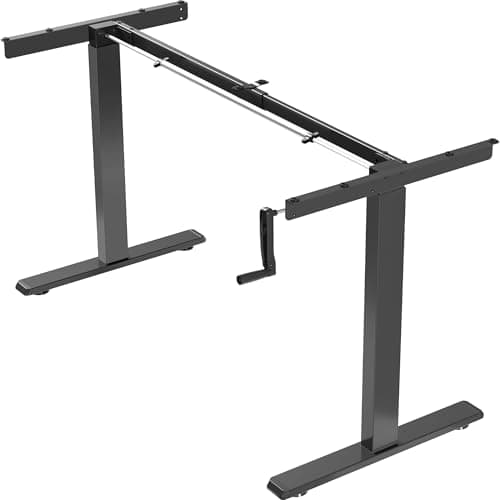
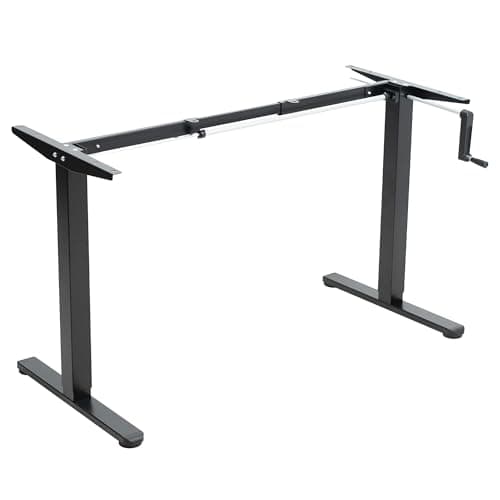
A crank takes somewhere between twenty and forty turns to travel the full range. That is not hard. It is just enough friction that on a busy afternoon you leave it where it is, and then you leave it where it is the next day too. Electric desks with memory presets get raised and lowered two to five times a day in most homes. Crank desks get set once and adjusted occasionally. That gap is the whole argument.
What manual genuinely wins on
- Nothing can fail electronically. The most common cause of a dead standing desk is not the frame — it is a controller board, a keypad or a motor. A crank frame has none of those. If you want a desk that will still work in fifteen years with no spare parts available, this is the honest way to get one.
- No power needed. A garage, a shed, a workshop bench, a studio with two outlets already spoken for. A crank desk does not care.
- Lower price for the same steel. You are not paying for two motors and a control board, so more of the money goes into the frame itself.
- Silence. No motor hum, which matters if you record audio at your desk.
What electric wins on
- Transitions per day — the metric that matters, by a wide margin.
- Memory presets. One button returns you to a height you have already dialed in with the elbow test. Without presets you re-find your height by eye every time, and by eye is how people end up an inch too high for a year.
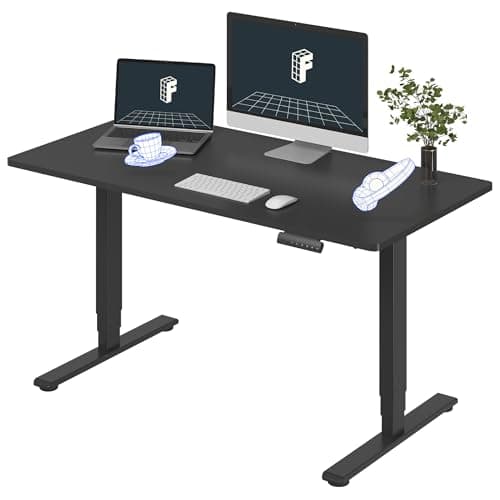
- Even travel under load. Dual-motor frames drive both legs together. A crank drives through a linkage, which is fine but less forgiving of an unevenly loaded top.
- Anti-collision. Better electric desks stop when they hit a drawer or a window sill. A crank stops when you notice.
The compromise most people should actually consider
A cheap electric frame under a top you already own beats an expensive manual desk on almost every axis, and it is often the same money. That is the FlexiSpot EN1 Standing Desk Frame (no top) argument: you get powered adjustment, you keep your surface, and you do not add another sheet of uncertified composite wood to the room. If the budget is the reason you are looking at manual, price this route first — the full case is in our budget standing desk roundup.
Reliability, honestly
Electric desks do fail, and the failures are annoying: a keypad that stops responding, one leg that drifts out of sync, a controller that needs a reset ritual. Most are fixable and many are covered, but they are real. What we would push back on is the idea that this makes manual the safer bet overall. A manual desk that you stop adjusting has failed too — it just failed quietly and you blamed yourself instead of the desk.
If reliability is your genuine priority, the better lever is brand and warranty rather than mechanism: buy from a maker with published spare parts and a support channel, and buy the frame warranty rather than the desktop warranty.
Which to buy
Electric, with memory presets, unless you are furnishing a space with no power or you have a specific reason to want zero electronics. If you go manual, go in knowing the trade and set a rule for yourself — crank at every break, not when you remember — because the desk will not remind you the way a one-button preset does.
Having settled on electric, there is one more spec decision underneath it: one motor or two, and two-stage legs or three. That pair of choices sets the travel range and the load rating, and it is where most of the price difference between budget and mid-tier desks actually goes — we work through it in single vs dual motor standing desks.
Choosing between a motor and a crank
Ask how many times a day you will change height
If the honest answer is three or more, buy electric. If it is once, a crank is genuinely fine — but be honest that once a day is not really a sit-stand routine.
Weigh presets separately from the motor
Not all electric desks have memory buttons. A hold-the-button electric desk without presets is much closer to a crank in behavior than the spec sheet suggests.
Check where the power is
An electric desk needs an outlet within the cable's reach at every height. In an outbuilding or a room with one socket already loaded, manual removes the problem entirely.
Compare frame steel, not features
At the same price, a manual frame usually has more metal in it because it is not paying for motors. If wobble is your priority and budget is fixed, that is a real point in manual's favor.
Consider the electric frame plus your own top
This is the option most people never price, and it usually wins: powered adjustment at manual prices, and no new composite desktop in the room.